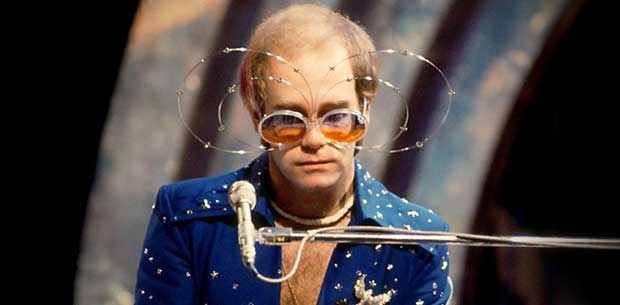
Even the rich and famous have to someday face death and decay. As morbid as that sounds, it’s true. Nothing stops them from aging and slowing down (other than Botox and maybe drugs, but that doesn’t guarantee immortality.) Even the young, vibrant artists we see today will someday become old – and maybe even (gasp) retire.
So while they can, they sing about being young and spontaneous. They sing about living their best life. Their songs can sometimes sound empty and meaningless to people who are older – that kind of lifestyle just doesn’t make sense anymore.
If you’re Elton John, you write a song about being in your sixties while you’re still in your twenties. At well over 60, Elton John is still doing very well for himself. (He’s coming to my town in the fall, and I’m slightly disappointed that I can’t see him live.) But when he was young, he was probably afraid to age like the rest of us. He probably wasn’t sure if he’d still be kicking at 60. Maybe a disease or war or even his own youth would kill him before then. So he expressed his worry and angst over the subject at a very young age.
Let’s take a look at Elton John’s picture of living sixty years on:
Day Eight: Sixty Years On – Elton John
The song, which released on his self-titled 1970 album, is very orchestral in its execution. It begins with the drone of a string section which crescendos into a rich bed of strings with a harp playing overtop. The harp surrenders to a plucked guitar as Elton’s youthful, elfin voice begins to sing.
Walk me down to church when I’m sixty years of age
When the ragged dog they gave me has been ten years in the grave
Senorita play guitar, plays it just for you
My rosary has broken and my beads have all slipped through
When Elton was young, sixty probably seemed like an old age, especially for a celebrity. Celebrities like to kick the bucket early due to their wild living (or, unfortunately, succumb to suicide.) He imagines himself as an old man being walked to church (maybe even being taken to church in his coffin.) The “Senorita” is an endearing term for Mary Magdalene, who may be waiting for him to arrive in Heaven – we’re looking at a man of faith who has turned often to his rosary beads. But maybe his faith has fallen through.
This song has taken on a special meaning to me in recent weeks. I was introduced to this song via a local radio station sometime last summer. On Sundays, our local classic rock station has a segment called Breakfast in the Basement. It used to be hosted by a local favorite who was called “Uncle Buck” by basically everyone. A few weeks ago, Uncle Buck passed away at the age of 69. Sixty years on, and we lost someone dear to our community.
“Sixty Years On” (which was actually not written by John himself, but a contemporary who was also in his twenties) was written during the Vietnam War, and the song smacks of anti-war vibes.
You’ve hung up your great-coat and you lay down your gun
You know the war you fought and it wasn’t too much fun
As the song progresses, it takes on the sound of a funeral dirge. The orchestral backing is slow and solemn, and the third verse is joined by the arpeggios of an organ. We think more and more of a funeral. Ironically, the third verse involves the older John looking back fondly, perhaps with fellow compatriots – or his children and grandchildren.
Yes, I’ll sit with you and talk, through your eyes relive again
I know in my vintage prayers they’ll be very much the same
And Magdalena plays the organ, plays it just for you
Your choral lamp that burns so low when you are passing through
The older version of himself seems to be ready to go, once he’s talked to his loved ones. (Ironically, Elton John became a father less than ten years ago.) He’s resigned to his fate, and really doesn’t see much of a future beyond his sixty years.
And the future you’re giving me holds nothing for a gun
I’ve no wish to be living sixty years on
That’s kind of harsh. Elton simply doesn’t want to be alive past sixty. He’s under the mentality that his best years are now (well, not now now, but the 70s.) And he’s somewhat right. He’s imagining a future of wasting away in a retirement home, doing nothing with the last twenty or so years of his life. But it doesn’t always have to be that way. I mean, Elton himself is a prime example of this. He’s making music and performing well into his twilight years. He’ll be remembered as an icon in his youth and into his age.
We tend to know Elton John for his poppy hits like “Crocodile Rock” and “Saturday Night’s All Right for Fighting,” and his soulful ballads like “Candle in the Wind” and “Goodbye Yellow Brick Road.” But I think “Sixty Years On” deserves a place at the table, for listeners young and old. Not only is it a beautifully written, sung, and orchestrated song, it’s a reminder that none of us have that much time.
And even when we’re young, we need to be reminded that we won’t be young forever.
So what will we do when we’re sixty years on?
 Audrey D. DeBoer