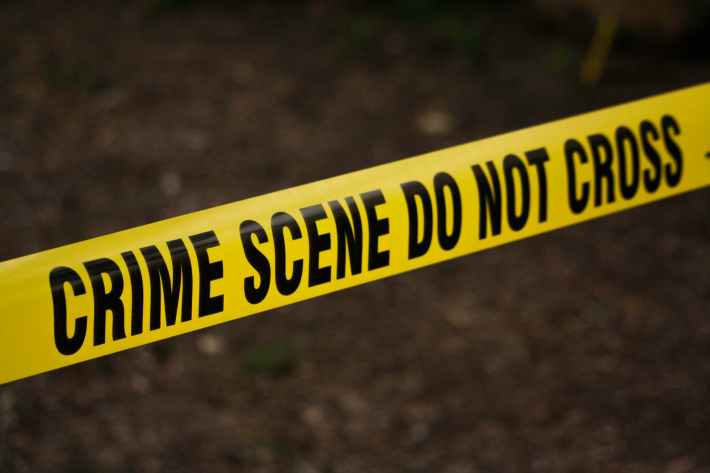
Lately, I’ve been on a bender.
No, not that kind of bender. I do have some standards. I’ve had a little bit more free time than usual, and I’ve spent it catching up on my backlogged Netflix queue. Do you know what 90% of my Netflix queue consists of?
That’s right! True crime documentaries.
In the past week, I’ve binge-watched Conversations with a Killer: The Ted Bundy Tapes, Evil Genius: The Story of America’s Most Diabolical Bank Heist, and I’m ankle-deep into The Confession Tapes, an anthology of docos about crime suspects forced or coerced into “false” confessions (false with an asterisk, because ???) If you’re picturing me in my bedroom with a corkboard filled with photos and question marks and strings connecting different pieces of evidence, you’re absolutely correct. (Not really. Or really??) But it made for some good fodder for a blog post on a blog about media. Because it brings up a good question – are we obsessed with crime?
And why is it that we (read I) are obsessed with crimes, criminal justice, and the long (and sometimes scary) arm of the law? Especially when it’s delivered to us in slews on screen?
I, humble reader, have come up with a few hypotheses.
So we know there are people worse than us. It sounds crude, but think about it. It makes the human psyche feel good to know there are “real” bad people out there. Maybe we did lie to our coworkers today, but at least we didn’t chop their head off out of uncontrollable anger, right? We aren’t this deranged psycho-killer like some of those people on TV. I think that’s a reason Conversations with a Killer: The Ted Bundy Tapes took off so much. Not only did it paint a psychological picture of one of the most diabolical men in history, it also reminded us that we’re not that screwed up. (Not yet, anyway.)
Being our own investigator. Most true crime docos play out in similar ways – it’s almost journalistic. You get the “what” – the exposition of the crime. The where and when is roped in there too. The fun bits are the “why,” and even better, the “who.” Unsolved crimes are especially tantalizing. I’m currently listening to a podcast called Monster: The Zodiac Killer. The Zodiac case out of California is decades old and still unsolved. There have been several suspects but no hard evidence to convict anyone. The clues and testimonies presented in the podcast lead you to ask your own questions and even sometimes draw your own conclusions.
If we’re being honest – shock value. It sells! And production companies know it! It’s the same reason (some) people love horror movies. How grotesque, horrifying, and just plain crazy can this (true) story get? I recently watched Evil Genius: The True Story of America’s Most Diabolical Bank Heist, and man, was that a roller coaster ride. What started as a bank robbery ended as a bombing of a maybe-innocent, maybe-guilty pizza man with explosives tied to his neck, a body in a freezer, and a clinically insane woman behind it all. It became a sort of car-crash-you-can’t-look-away-from situation. I digested all four episodes in the course of about a day. Shockingly, horrifyingly fascinating. Why would they still make them if they weren’t?
The power of narrative. A true crime story has everything a good story needs. Inciting incident, plot, heroes, villains. Human beings love a good story. True crime has the added benefit in that it’s true. And as we know, sometimes the truth is stranger than fiction.
And of course, good old-fashioned human depravity. Being a degree or two removed from a cataclysmic and sometimes tragic event (ie, watching a crime on a Netflix documentary) it’s easy to sit back and judge and to feel like it’s no more than a TV show. And somehow, it’s entertaining. It’s like I said before – a car crash that’s so horrible you just can’t take your eyes off it, like a kind of second-degree rubbernecking. The truth is, we are entertained by how horrible people can be. I’m not sure I could fully explain why. But at the same time, we like to see justice carried out. It’s satisfying when these crimes are solved. It’s tantalizing when they’re not, in which case, we put on our own detective hats and try to piece clues together like the armchair experts we all try to be.
 Audrey D. DeBoer