If you’re anything like me, you spent three hours of your weekend with your butt glued to a movie theatre seat, along with billions of other people across the globe. Was it to see Penguins? Maybe, but probably not.
See, if you’re like most people who want to avoid spoilers, you went to see Avengers: Endgame this weekend so all of those spoilers-out-of-context make sense. And good on you for doing that, because it was definitely worth seeing opening weekend. Even after some of us are tired of ten-plus years of superhero films from a big-budget film company, we sat back in our seats in tears, shaking our heads, and saying, “Gosh darnit Marvel, you did it again. You made me care about these guys.”
Because no matter how much we bemoan the existence of a slew of superhero films, Marvel and DC alike, remake or original, one-shot or franchise, we still keep going to see them. In literal droves. You could argue that they’ve cultivated these fanbases by systematically releasing movies that are connected – basically forcing you to return to the theater for them every year – but you gotta admit, there’s something about these movies that is intoxicating. Other than, of course, Captain America’s butt (I mean, c’mon.)
I get it. These movies are flashy, fun, sometimes serious, sometimes silly. The actors and actresses are attractive, they wield cool weapons and have iconic hairstyles and costumes. And over the last few decades, these roles have come to define their careers. And some of the characters they portray have come to define us as a culture. These films have become a shared experience.
But underneath all that pomp and pizazz, that Alan-Silvestri-infused theme music, those big purple baddies and universes uncharted, there’s a beating heart.
We want heroes.
But not just any hero. The hero. And who is the hero? I think we’ve been trying to figure out that formula for a long time. What ingredients do you put together to create the Perfect Hero? Obviously they stand for truth and justice (Superman,) but they have to be at least a little bit relatable (Spider-Man) and maybe a little gritty too (Batman) and also have cool gadgets (Iron Man) but still be down-to-earth, so to speak (all of the Marvel Netflix originals.) Or maybe just hot? (Thor.) Wait. This is getting complicated. Who is a hero?
You might say Marvel has adapted the perfect dashing-hero-with-a-silly-side archetype. Their heroes are colorful, quippy, and have biceps for days. They live in the light, and fight off their own darkness. Conversely, DC has been edgier (at least in the cinematic universe.) Furrowed brows, dramatic monologues, rainy streets. Very film noir, if you think about it, but with more CGI chins. Yet, they’re both trying to portray the same kind of hero. A good one.
There’s a difference between good heroes and great heroes though. Because great heroes are flawed.
(Warning: Spoilers Ahead)
What Makes A Good Hero
In writing, there’s an archetype called a “Mary Sue.” Mary Sue is the it girl. Everyone wants to be her. She’s beautiful and perfect and does virtually no wrong. She always makes the right decision. The male version of this is sometimes referred to as a “Gary Stu.” It’s one of my favorite archetypes in writing to shred to pieces (and be extremely mindful of in my own.) And you know who falls into these tropes the easiest? That’s right, superheroes.
Take Superman for instance. He’s what you might call a textbook Gary Stu. Like, he’s pretty much perfect, even when people try to humanize him. He’s not even a human. It’s cute that we try to make him relatable, but honestly, he just can’t be. He was created as a “savior.” I mean, if you watched Superman Returns and didn’t see all of the Christ imagery, did you even watch it?
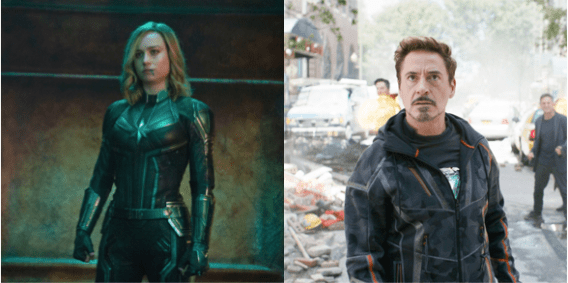
Another Mary Sue, I’d argue, is Captain Marvel. In the Marvel Cinematic Universe, she’s the embodiment of Mary Sue, and while we’re at it, a Deus ex machina. We got one movie about her that vaguely outlined something like a character, but really just ended up being a plot device in Endgame. And Carol Danvers deserved way better than that, believe me. She deserves a Captain-America-esque suite of movies, but she was only needed for one thing – to swoop in and save the day. Much like Superman.
So the Mary Sues and the Gary Stus of the superhero world are cool and all, but they tend to be…well, bland. Let’s spice them up a bit, shall we? Let’s give them character flaws. Take another superhero blockbuster of the year – Shazam. Yes, he’s a hero, but he’s also a fourteen-year-old boy who turns into Zachary Levi when he says the magic word. So he’s got fourteen-year-old boy problems. Like selfishness. And also abandonment issues because he’s an orphan (sort of.) It makes him a bit more interesting, and a tad bit more relatable. And maybe more palatable too. Oh, we could also add in a tragic backstory. Looking at you, Batman, and all of the other countless orphaned superheroes out there.
So yeah, I’d argue Superman is a “good” hero. Captain Marvel is a “good” hero. And so is Shazam. There’s one thing that separates them from the great ones.
What Makes A Great Hero
If you want to figure out who a great hero is, you gotta raise the stakes. There has to be a lot on the line – let’s just say, half the population of the universe? Yeah, I’m gonna talk about Infinity War and Endgame, so deal with it. The Avengers pantheon has a lot of really good heroes in it. I’m only speaking as someone who is familiar with the MCU, but each hero has a turn to be hero-y, either in their own film or one of the ensemble pieces.
The same goes for the last two films of this Avengers cycle. There’s oodles of “good” heroes. They are fighting for justice, for family, for all things good and right, you might argue. Basically, they want their friends back, and they want to do what’s right for the world. And they’re pretty well equipped to do it. They have strength, stamina, and abilities that most of us don’t have. Coolcoolcoolcool. But I want more.
I want sacrifice.
A hero can show you their strength, justice, and goodness all day. But what separates a good hero from a great hero is how they react when the stakes are high. We had a lot of good heroes in Endgame, but we only had two great ones – Black Widow and Iron Man. Two Avengers who, arguably, don’t have supernatural abilities (other than one is really rich and can afford a weird sort of heart replacement thing.) The stakes are sky high in the film, and you could argue that it would make sense if any of the Avengers were to put their life on the line. But it’s particularly poignant that these two end up risking – and losing – their lives for their friends. Black Widow is an assassin with a prickly personality. Iron Man is a billionaire-playboy-philanthropist who, at this point in the franchise, has everything to lose. But at the end of the day, both of them were willing to risk and lose everything they cared about in order to make the world a better place.
Would Superman do that? I mean, probably. Captain America probably would too – heck, Underdog might even do the same thing. But it makes more sense that the least of these, so to speak, were the ones to make the ultimate sacrifice. To begrudgingly quote Thanos, “The greatest sacrifices require the strongest wills.” It’s not just about how big your muscles are, or how sternly you look off into the distance, or whether or not you were shot up with radioactive chemicals. A willingness to sacrifice yourself is proof that you have that beating heart we’re all looking for.
 Audrey D. DeBoer
I would argue Captain America is the epitome of a great hero. Even before he was super charged in his early days, he displayed his willingness to sacrifice his life for everyone else. The grenade, rushing in to save his comrades alone despite receiving orders not to, plunging the plane into the ice to prevent the destruction it would cost thinking he would die. He continuously circumvents the shackles placed on him by the government to help others while remaining in the shadows, along with Natasha (civil war/infinity war). Finally in his battle with Thanos in Endgame he has his indestructible sheild half demolished by a titan who tosses gods around like rag dolls and still readies to stand alone against the thanos invasion before the rest of the avengers. He does have a contradiction or two (didn’t want vision to sacrifice himself for the great good, even though he would without a second thought) but his undying devotion to sacrifice himself for what is right, puts him in the great category along with Tony and Natasha.
LikeLike
That’s good insight! Thanks for sharing.
LikeLike