
The dust has settled. As of today, it has been about three weeks since Star Wars Episode IX: The Rise of Skywalker was released. Obviously, the Internet exploded, because no one can have a calm, concise opinion anymore (we’ve all read the reviews for Cats.) I’ve waited for a little bit to let the masses and critics sound off (and enjoy the memes) as well as discuss theories and problems with friends and fellow fans.
After this digestion period (yum,) I did some watching and re-watching of the films, specifically the newest trilogy. While I was rewatching, I thought: Hey. This sounds like something else I’ve read. In the Book of Acts.
In the Bible.
To be clear, this blog post is going to focus on the newest trilogy, episodes VII, VIII, and IX (The Rey trilogy, if you will.) Not only are these some of the most controversial of the films, but they are also rich with context and character. In the new trilogy, a new world is built for us: A post-Empire world still reeling from the effects of the regime and a plucky group of rebels trying to make the world a better place.
So I figured, why not explore these ideas? These movies probably were not intentionally allegorical, but as a Christian and consumer of all things media, it’s good to look at the deeper meanings of things and discover the implications they can have in the way I think and live.
Star Wars and the Early Church: They’re a Lot More Similar Than You Think
BE WARNED: This will contain Rise of Skywalker spoilers. And general Star Wars spoilers. So if you haven’t watched any Star Wars, first of all: where have you been, second of all: maybe take a hot minute (or several hours) to watch them, if you care about things being spoiled in general. Cuz it gonna happen.
The Setting
For context, let’s go back to the original trilogy. We’ve got a teenage boy who is the son of The Chosen One (our boi Anakin.) He and his sister (introduced later) were born in a time of great political and socioeconomic strife in the galaxy when the Jedi religion was dying out and they were holding out for hope. This was not unlike the Israelites waiting in anticipation for their Messiah to come. Luke and Leia do have “savior” aspects to their characters, but I wouldn’t draw them as specific Christ figures in the films. However, the parallel of their birth is there. And they are the ones who end up saving the galaxy from the Empire, just as Jesus conquered death.
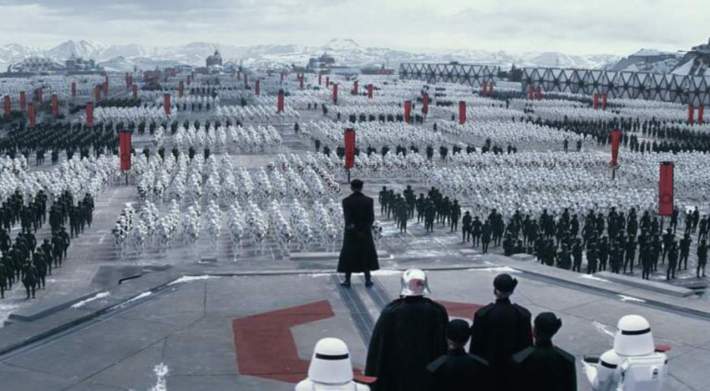
Fast forward to a handful of decades after the events of Episode VI. The Empire has been defeated, but a new evil has arisen – The First Order, which seeks to take full dictatorship of the galaxy and rule it with the Dark Side of the Force. You can draw a pretty strong relationship between this and the expanding Roman Empire of the early church. Rome was on a mission to basically rule the known world by any means necessary, and many Roman cities were wary or even violent toward Christian communities, just has the First Order had a zero-tolerance policy on Jedi and the Rebellion. Enter said Rebellion, doing its best to combat the darkness that was taking over the world. Much like the early church, the Rebellion was a grassroots movement (stemming from Luke and Leia, the “savior”-ish figures of the original trilogy) that in times of danger had to hide from the First Order. In the opening scene of Episode VII, we see a Rebel sympathizer and his village get terrorized by Kylo Ren and the First Order, not unlike the persecution early Christians faced at the hands of the Roman Empire. (Peep the story of Stephen in the book of Acts.)
The Characters

In The Force Awakens, we are met with eager members of the new Resistance, including General Leia Organa, who has picked up where her brother left off. At this point, we meet a plucky young hero and the new “savior” of the saga – Rey. Rey’s story has parallels to that of Peter in the New Testament. Rey was not necessarily “chosen” by someone to spearhead the new Rebellion and rebirth of the Jedi, but she did feel an innate calling for a purpose beyond her scavenging life on Jakku.
Then, we get a smattering of other key characters that have parallels to the narrative of the Early Church. When a Rebel sympathizer is killed in the opening of The Force Awakens, there is a Stormtrooper present to witness it – FN-2187. Guess who was present at the stoning of Stephen? That’s right, our boy Saul, looking after people’s coats while they hurled stones at the Christian. Saul was a Jew to a T. He followed orders and was raised to hate “the Way,” which was seen as a threat to Judaism. He was converted on his way to Damascus when Jesus came to him (Acts 9) and became Paul, just as FN-2187 had his own revelation and became Finn, a Resistance member.
But there is another character who has Saul-to-Paul tendencies but in a different arc. And that is hunky goth Kylo Ren (yes, I called him a hunky goth and no that wasn’t a typo.) Unlike Finn (and Paul,) Kylo (formerly known as Ben Solo) was raised in the ways of the Force but turned from them as an adult. He became an edgy, Goodwill-version of his grandfather, Darth Vader, and attempted to follow the ways of the Sith. So like Saul, he had a strict mindset on how the universe was supposed to work for better or worse. His redemption arc is a bit more drawn out than Finn’s, but includes several of the key characteristics. First of all, Kylo has an “encounter” that causes him to “convert.” In The Rise of Skywalker, he encounters a vision of his father (whom he killed in episode VII.) After this, he is again Ben Solo and dons a galactic-Forever-21 gray knit instead of his weird space dress. One of these is a parallel to the story of Paul (hint: it’s not his fashion choice, but the scoop-neck pullover is a good look for him.)
The Force

For context on the Force, we will have to once again explore the original trilogy to get a grasp on the concept. In A New Hope, Ben Kenobi describes the Force to Luke: “It’s an energy field created by all living things. It surrounds us and penetrates us. It binds the galaxy together.” George Lucas took the idea of the Force from several world religions, not just Judeo-Christianity. What interests me about the concept of the Force is how not all characters are completely on board with the idea of it, especially in the original trilogy. Han Solo is a nay-sayer when it comes to the Jedi religion. “Kid, I’ve flown from this side of the galaxy to the other,” he tells Luke in A New Hope. “I’ve seen a lot of strange stuff. But I’ve never seen anything to make me believe that there’s one all-powerful Force controlling everything.”
Nay-sayers are common in the Bible. We have our very own resident nay-sayer, Thomas (who, granted, was a follower of Jesus, but wasn’t quite sure that He was raised from the dead til he saw it himself.) It’s safe to say that Han becomes a convert (I mean, he marries Force-sensitive Leia and his kid ends up being a Jedi/Sith.) It makes me think of what Jesus told Thomas in John 20:29 after revealing Himself: “Because you have seen me, you have believed; blessed are those who have not seen and yet have believed.”
Because in Star Wars, we have people who have seen and believed (Han had to see it for himself,) but then we have those in the new trilogy who have not seen the greatness of the Jedi but still believe in the cause of the Resistance and bringing balance to the Force. Rey is one of these people, a young woman with an intense connection to the Force but who, in the end, does not become a tried-and-true Jedi (she’s rocking that yellow blade, yo.) Rey is somewhat like the Peter of the Rebellion. Peter was the “rock” upon which Jesus would build His church, and Rey is “the spark that ignited the fire” that the Resistance needed. She performs “miracles” (including healing that kinda-cute worm-snake thing and then healing Kylo Ren) through the Force as Peter performs miracles through the Holy Spirit.
This is addressed often in The Last Jedi, which is one of the many reasons I enjoy that movie. I like it because it teeters on universalism, which is a unique perspective and makes the allegorical aspects even more interesting. Luke, who in The Last Jedi is salty and old, understands that the Jedi are an old, dusty religion, and the film explores the fact that the Force is something that is accessible to all, not simply Jedi or Sith. Is it an argument for universal salvation? I don’t know if the director was thinking about it that way, but as a Christian, it was an interesting concept to watch unfold onscreen.
So what does it all mean?
I doubt that these parallels and connections were intentional. Rian Johnson was a self-confessed youth group kid, though. And if there’s anything I know about youth group, it’s that that stuff sticks with you. The story of the early church is a story of hope in the midst of chaos, of light in the midst of darkness. It’s a story of setbacks and challenges, of mistaken identity and radical conversions. It’s arguably just as exciting as a space opera in a galaxy far, far away. So it makes sense that these two narratives are so closely linked.
Fiction has a way of helping us understand our world in different ways. When we watch movies like the Star Wars franchise, we come for the cool spaceship battles, weird aliens, and compelling aliens. But we stay for the messages that are at the heart – that in the end, no matter how hopeless things seem, good will win in the end.
 Audrey D. DeBoer