I don’t even remember the first time I went to our local symphony. It wasn’t an odd way for our family to celebrate a special night out. Almost annually, my parents took us to see the Nutcracker. I remember one night my brother and I listened to the music as we fell asleep. We both developed a love for that music early on (my brother was/is obsessed with Star Wars, so he had John Williams playing somewhere in the house more often than not.) Without a doubt, classical music in general is ingrained in my childhood and in my adult life.
Call me a fish in water, but I think classical music is important. And by classical, I mean symphonic and orchestral music in general. Classical is a term most people use as a blanket statement to cover all eras of orchestral music, from Baroque to the Romantic period. The actual “classical” era of music was between 1750 and 1820, but you’re not wrong to use the blanket term. (More on the jargon later.) Classical artists set the stage for themes and motifs that are still used in contemporary music today. They developed the theory and technique that musicians still use. Some might say that this is pigeonholing music in general – only giving credit to classical artists. And I’ll agree – the world has a wealth of music, but I think the music that has influenced us the most in Western culture is what we think of as our “classical” music (Bach and Beethoven and all those guys. It’s a deep and abiding part of our musical tradition, though we’ve been influenced by other cultures of music as well. But that’s not really my area of expertise.)
So instead of shooting off at the mouth about classical music, I’m going to…shoot off at the mouth about classical music. But in a more rhetorical way. Hopefully. But not so rhetorical that it’s pretentious, yeah? Okay. So in the next few weeks, I’ll be writing a series on “classical” pieces that you should know. If anything, you can use the mini tidbits of information to impress your friends. I hope these little write-ups on some truly *classic* (haha) pieces will help you appreciate where we’ve come from as a culture of music.
Our first victim: Danse macabre, opus 40, by Camille Saint-Saens (sahn-SOHN)
First of all, what the heck is an “opus?” An opus can mean two things: a composition by a particular composer, arranged by date; or any artistic work by any artist. The latter definition is used more melodramatically (“His painting was his last great opus“) where the former definition is more straightforward – it’s simply a fancy way for composers to put their music in order for posterity’s sake. Think of the first definition when you think of classical pieces.
Who is Camille what’s-his-face? He’s not a hipster, in that you’ve probably heard him before (if you’re listening to Danse right now, it probably sounds familiar.) One of his other famous works is Carnival of the Animals (this movement, “Aquarium,” also probably sounds familiar to you.) Saint-Saens wrote in the Romantic era of music, which is exactly what it sounds like. Everyone was very dramatic all the time. The Romantic era of music coincided with the literary movement Romanticism. In general, everyone was extra about everything – their emotions, their usage of words (have you read a book by Charles Dickens?!), and their music. Saint-Saens was very extra. Think Lady Gaga at the 2016 Superbowl level of extra.
So what’s Romanticism? Like, kissing and stuff? Sort of? Romantic composers went to extreme, in that their music would be very soft one minute and hecka loud the next, as you might notice in Danse. They also used range as it related to the notes they use – you can hear that in the dynamic violin that dominates the Danse piece. Not for the faint of heart. One last characteristic that’s important to this particular piece is the huge as heck orchestrations. You can hear that in the grandiose sound of Danse.
Now that these questions have been semi-adequately answered, let’s look at the piece itself. Make sure you’re listening right now, mkay?
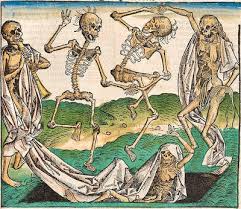
Danse macabre is what intellects like to call a tone poem. The piece is literally based off a poem written by a French poet named Henri Cazalis. And if you know anything about the word “macabre,” you can guess what the poem is about (generally.) Yep. It translates to “Dance of Death.” The piece that Saint-Saens wrote is literally meant to tell the story of the poem using musical motifs instead of lyric motifs. And guess what – the poem is weird.
Zig, zig, zig, Death in cadence,
Striking with his heel a tomb,
Death at midnight plays a dance-tune,
Zig, zig, zig, on his violin.The winter wind blows and the night is dark;
Moans are heard in the linden-trees.
Through the gloom, white skeletons pass,
Running and leaping in their shrouds.Zig, zig, zig, each one is frisking.
The bones of the dancers are heard to crack-
But hist! of a sudden they quit the round,
They push forward, they fly; the cock has crowed.
If that isn’t a trip, I don’t know what is. (Opioids were a big thing in the 19th Century. Just sayin’.)
But if you really listen to the piece, you’ll really see that it mimics the cadence of the poem itself. At the beginning, the harp plays the same note twelve times – the stroke of midnight. Just listen to the initial tritones of the solo violin. Arresting, right? In music, tritones are considered “the Devil in music” because they sound so ugly and weird (most church music in Medieval times was not allowed to include tritones. Obvs.)
And then the freaky graveyard dance starts, because dead people are into that kind of thing. To make things better, they are literally dancing with Satan, who has an affinity for the violin in both classical music and bearded folk/country bands. If you ever wonder what skeletons sound like when they’re having a ghostly hoe-down, listen to the xylophone – it’s meant to sound like bones rattling around. Yeah. Bones. Thanks, Satan.
After the two main themes of the music get tossed around by different sections of the orchestra (the two main themes are the fluttery notes you hear at the beginning by the flutes and then the grandiose, eerie string theme), the whole orchestra comes in with one last hurrah. It’s the pinnacle of the ghostly dance – but then, the music abruptly stops and you hear one singular instrument: an oboe. The oboe is supposed to represent the rooster crowing, signifying that dawn has come. Satan’s gotta hoof it before the sun comes up, but before he does, he plays one last melancholy line on his fiddle, then all the bones gotta scoot.
So there it is. Danse macabre, the Dance of Death. It’s ironic that I’m starting this series with a piece about death, but I thought the dynamism of this piece would be a good place to jump in.
Give this piece a listen – I’d love to hear your thoughts. Next week, get ready for a whole lotta Russian love with Tchaikovsky!
a. w.
 Audrey D. DeBoer
[…] Classical Crash Course, part one: Danse Macabre […]
LikeLike
Nice analysis and very funny, thanks!
LikeLike