“What if?” We ask ourselves that question a lot. We imagine if a decision or action could have changed the trajectory of our lives. What if we’d said yes to that business proposition? What if we had turned down our current partner or spouse? What if we had moved to a different city, state, country? Where would we be now? It doesn’t do us much good – it’s just speculation, isn’t it?
But what if an alternate version of ourselves is playing out that alternate reality right now, living in that city, owning that business, married to that person? What is that version of us like? What if, somehow, you’re connected to another version of you living out your possible timeline?
That, my friends, is what’s at the heart of the many-worlds interpretation of quantum physics. (Yes, I studied quantum physics just for you. For like ten minutes. On Wikipedia.)
This theory of quantum mechanics, developed initially by a guy named Hugh Everett in 1957, asserts that the many possible histories and futures of the universe – including that of each individual – are real and have happened, but in universes parallel to ours. In fact, some theorists say there’s an infinite amount of possible universes parallel to ours. (I won’t go into why or how they know that. Like I said, ten minutes.)
Think Schrodinger’s cat. This theory looks at the many-worlds interpretation as branch-like. You make a decision with a “yes” or a “no,” and both possibilities branch off. There might still be a you who made the opposite decision, but you’ll never know – hence, parallel.
You’ve seen this before – this is familiar. Because Hollywood loves this. Movies like Serendipity and the Back to the Future franchise play with this idea. How tantalizing is the idea that your entire future could be changed based on one decision you make – even as minute as the direction you take to work? I mean, the plot writes itself. Boy could meet girl – but what if he just misses her? Girl could take that job – but what if Attractive Female Rival gets there first? And what if we had some sort of conduit to figure out these multiple paths? (Like maybe a DeLorean?)
Or what if someone was making those decisions for us?
I recently watched two films that have their own takes on quantum theory, or whatever you’d like to call it. So let’s go…into the bander-verse.
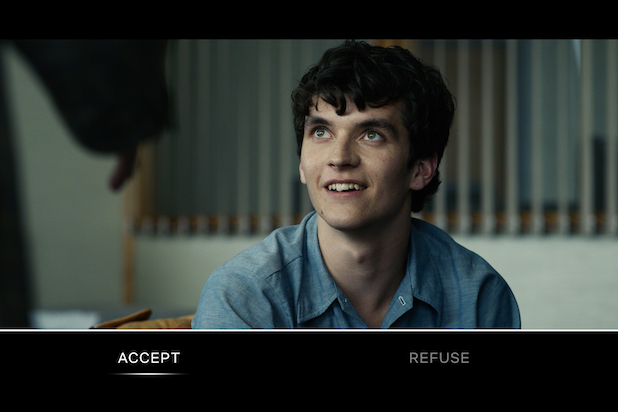
Bandersnatch – “I am being controlled by something called Netflix.”
(Warning: If you haven’t seen this and want to, I’m about to apologetically spoil so much.)
It’s 1986. A young computer programmer has created an inventive, immersive game such that the world has never seen. He decides to pitch it to a big-box software design company, and guess what? They love it. They give him an offer, even a team of designers to help him get it developed and on the shelves by Christmas.
So what’s his answer? Yes or no?
Plot twist: It’s up to you.
You, who are sitting in front of your computer in 2019, eating pizza rolls and wrapped in a fuzzy blanket you got for Christmas. The excited executive is pitching 19-year-old Stefan this question in 1986, and a black bar appears at the bottom of the screen with two words – ACCEPT and DECLINE. And your mouse decides what happens next.
Black Mirror: Bandersnatch is an immersive choose-your-own-adventure story that offers you several timelines as you navigate the world of Stefan, our prodigy computer programmer. From decisions as huge as whether or not he flushes his medication down the toilet to as trivial as what sort of breakfast cereal he has, you are in control of most of Stefan’s decisions.
And I’m not gonna lie, it’s kinda fun.
Well, I use the term “fun” lightly. As you navigate Stefan’s multiple narratives, he encounters another young computer programmer named Colin. Depending on what narrative you follow, Colin begins to counsel Stefan about game programming, especially when Stefan hits a snag in his work. Colin helps him open up his “third eye,” so to speak. (And he obviously does that doing drugs because how else.) This is when Stefan’s world begins to unravel.
“If you listen closely, you can hear the numbers,” says Colin while they be trippin’. “There’s a cosmic flowchart that dictates where you can and where you can’t go. I’ve given you the knowledge. I’ve set you free. Do you understand?”
He goes so far as to challenge Stefan – they stand on the balcony of Colin’s high-rise apartment, and Colin asks him a question. Who’s going to jump? Because if he’s right, they’ll simply enter into a different, alternate timeline. They won’t actually die.
But it’s not up to Colin – it’s up to you.
I’ll warn you now – don’t “play” this movie if you don’t feel like making some morally shady decisions for Stefan. You decide whether or not he kills people. Eventually, there comes a point in the timeline where you can “reveal” yourself to Stefan, after he starts to wisen up to the fact that someone might actually be controlling him. After that Stefan becomes woke to the point of near insanity, and visits his counselor, who has been helping him cope with his mother’s death.
“I’m being controlled by something called Netflix,” Stefan says in one timeline, which out of context is hilarious meme-fodder. His counselor notes how silly that notion is – wouldn’t someone want to “watch” something more interesting? (Spoiler alert: it gets weird after that.)
But she poses an interesting question – how far will we go to be entertained? At one point in the “game,” I had to decide what Stefan does with his own father’s body. Me, sitting in my PJs in front of my Macbook, telling an actor who filmed this months ago what to do and being totally into it. And being totally into it when he gets thrown back through his timeline to the beginning – so you can make a different decision for him.
Sounds kind of like quantum theory, doesn’t it?
According to the director, there is about 5 and a half hours of footage that you can navigate through in Bandersnatch, depending on the choices you make and timelines you construct. There are endings, but I don’t think any of them are definitive. I reached a few of these endings – a few of which found our hero (?) in prison for murder (that you helped him commit…)
Bandersnatch is an immersive film that takes the “what ifs” to a whole new level. Depending on what you believe, it can open your “third eye” of reality. It definitely made me stop and think a minute. While the film’s concept of free will is a bit sketchy, it’s hard to understand time or timelines as anything other than what it is because we constantly live within it – the whole fish-in-water thing. I don’t know enough about quantum theory to know if it’s even possible to be one person with an infinite number of pasts and futures (and don’t even get me started on government mind control) but it’s enough to make me think twice about how much I let external forces decide things for me.
But quantum theory can be fun, kids! Case in point:
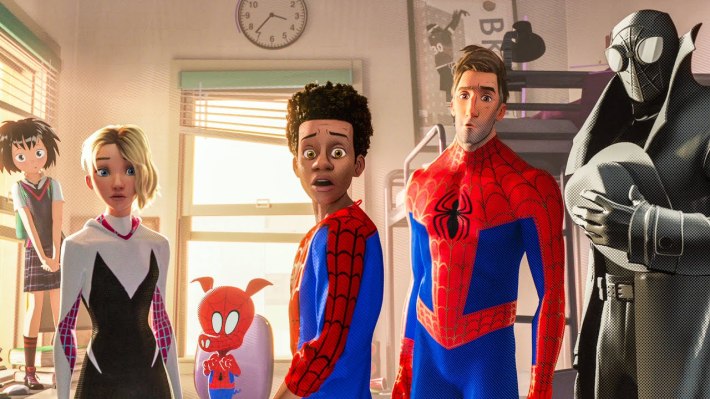
Spider-Man: Into the Spider-Verse – “Alright, let’s do this one last time…”
I’m gonna come clean: superhero comic books are confusing to me. I think they’re a cool medium to tell a story, but there are so many storylines. There’s the originals, of course, but new writers are constantly taking up old mantles and putting new spins on old characters. It’s fun, but it can easily become a messy web (no pun intended…yet) – especially if you’re not well-versed (no pun intended…yet) in comic books.
But sometimes, someone comes along and makes it fun and cool and unique and slightly less confusing. Using quantum theory.
In the recent Spider-Man adaptation (lauded as one of the best,) we meet teenager Miles Morales (woke comic-book-readers will already know this alias as one of the various Spider-Men) as he struggles with growing up in Brooklyn. But of course he gets bitten by a radioactive spider so life gets even more interesting. But it gets even more interesting when baddie-on-the-block Kingpin decides to open up a black hole connecting a bunch of alternate timelines, sending four alternate Spider-Men (and women. And…pig) into our world. So Miles has to deal with his own transformation as well as the appearance of a washed-out Peter B. Parker, a jaded Spider-Man noir, spunky Spider-Gwen, kawaii Spider-girl, and…Spider-Ham.
What results is a chaotic visual treat that reads (or watches?) like a comic book. The movie doesn’t delve too deeply into the nitty gritty of quantum theory (because I mean, who wants to) but their logic makes sense. Kingpin and his cronies (The Sinister Six, if you’re into that kind of thing) open the time-hole-thingey in a controlled environment in an attempt to open up a parallel timeline, but if someone or something jumps out of that timeline, their atoms get kind of wonky and unstable. They don’t belong in that realm, they belong in their own separate realm. I mean, I only studied quantum physics for ten minutes, but that adds up.
Neither of these films are out there to answer any big questions about the state of our universe, but they can make us look at it in a different way. Bandersnatch is all about how much we let preconceived notions and external forces determine the choices we make for ourselves, and Spider-Man, while mostly a fun romp, is thoughtful when it comes to the morality of warping timelines or “starting again,” so to speak.
It also makes for some fun storytelling.
 Audrey D. DeBoer
[…] Spider-Snatch: Into the Bander-Verse […]
LikeLike