If it’s the end of 2019 and you run a blog that’s about media, there’s one thing you need to cover before the year is out.
That’s right! Frozen 2!
Actually, no. I haven’t even watched that yet (but I have enjoyed the memes.) Since the first time I sat down to watch the first episode of The Mandalorian, I knew I had to throw my voice in the echo chamber like everyone else. What would I do? Would I create a new Baby Yoda meme? (If that’s even possible at this point?) Would I try to start an argument? (Which is possible to do with Star Wars fans on almost any topic ever?) Or would I just talk theories incessantly like everyone else in the world?
Until I got an idea – to deep-dive into the intricacies of what makes The Mandolorian so good, which is its storytelling. So here’s five things that the show can teach (and re-teach) storytellers about the craft.
This article contains heavy spoilers. I have spoken.
1. Show, don’t tell.
With every new Star Wars storyline, there’s a lot of lore to unpack. Sometimes it’s done well, sometimes it’s not. A layman isn’t necessarily going to know the intricacies of the timeline of the story, the culture of Mandalorians, or the role of a bounty hunter in this universe. Such is the problem for many a writer trying to give the right amount of backstory (I’ve been there. Note to self: exhaustive flashbacks don’t work.) Yes, we get flashbacks of the Mando’s separation from his parents at a young age, but we don’t get a long-winded testimony of how it affected him. We can glean from the shots of a young boy being hidden from bombs and gunfire that the story didn’t end well for his family. We can surmise that from the beaten, battered look of the Storm Troopers in The Client’s employ that we’re a few years out from Episode Six. We’re faced with a tattered Galaxy trying to piece itself together – and no one really had to tell us that.
2. A flawed main character.
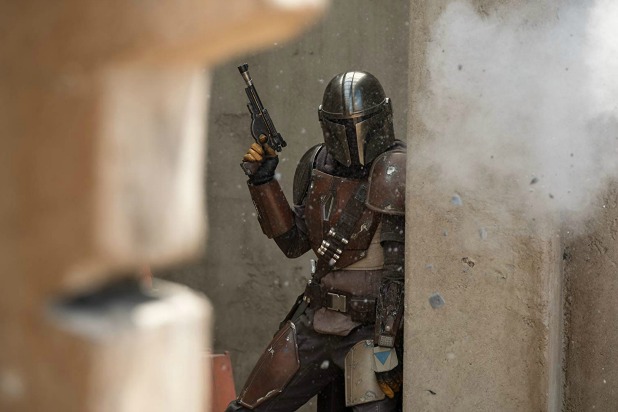
The worst kind of character is a Mary Sue. A Mary Sue (or her male counterpart, Gary Stu) is a main character who is literally perfect – all of their decisions are correct, their moral compass points to True North every time, and they’re like, really hot. It’s an easy trap for storytellers to fall into. Yes, main characters should typically be admirable. They should have at least one redeeming quality (because we all do.) But they should not be absolutely perfect. Perfect makes them unrelatable and flat. Pedro Pascal (who plays the titular character) describes his character as having a “questionable moral character.” We love him, but he makes bad decisions sometimes. I mean, he’s a bounty hunter, which is basically the definition of moral ambiguity. The first episode does not set him up as the most likable guy (it involves freezing a bounty in carbonite if you’re just catching up.) But by the end, we see the “moral” part of his “questionable moral character” when he stops and IG unit from killing The Child. Flawed, but redeemable. Like all of us. Except we don’t have cool, shiny armor. Plus, we’re yet to find out how attractive he is, tbh.
3. The power of a “lone ranger.”
Pascal has also likened his character to some of Clint Eastwood’s more memorable roles, all of which typically fall within the “lone ranger” trope. The series so far has rarely zoomed out of the Mando’s story. He wanders around the Galaxy in the same way Eastwood wandered around the desert, probably with a piece of wheat in his mouth or something. A “lone ranger” character done well is powerful. A “lone ranger” character done badly is mopey at best. Case in point: Armie Hammer in Lone Ranger (2012.) I’m sorry, you beautiful beautiful man, but there was nothing interesting about you in that role. Mando is a redeemable lone ranger. While it does mean we get fewer recurring characters (he is a drifter, after all,) it also means we get some tight character development. Supporting characters are great, but too many of them muddy the waters. And if you think about it, very few of us have “sidekicks” or recurring characters in our lives that follow us basically everywhere. It also opens the door for more character development on Mando’s part – his predicament is such that he’s going to need help, eventually. Just maybe not all at once.
4. Introducing conflict.
We really don’t get conflict in The Mandalorian until the very end of the first episode. It really does take its time with exposition, but not the boring kind. We get a snapshot in a day in the life of our gruff, monosyllabic friend, and then boom. He’s thrown into a very perilous mission. But is that our overarching conflict for the series? Is this going to be an eight-episode saga of him trying to secure the bounty? Well yes, but actually no. The inciting incident really doesn’t happen until he discovers The Child. Then our friend gets some enemies, and the series becomes about the Mando’s struggle with abandoning the culture of his people (and profession) because of a series of moral decisions he’s made. A few Jiujitsu moves later and he is the single parent of Baby Yoda – and the conflict becomes even direr than we initially thought. Conflict is a tricky tightrope for storytellers – how much exposition do you need, and when does the inciting incident come in? Of course, it’s a sliding scale, but too much or too little can lead to a weak narrative.
5. Compelling background characters.
So we’ve already covered the lone ranger trope, and in doing so we talked about how characters come and go in Mando’s narrative. The only truly “recurring” character in this series so far is The Child. Everyone else has been featured in, at most, two episodes. You could argue that The Child is a sidekick, but really, he’s just…The Child. The Mando didn’t ask for him, but now it’s the cargo he needs to deliver to safety. All other characters are either helpers or hindrances to his journey, and they all have interesting arcs in and of themselves. We all know and love The Armorer and how she acted as a peacemaker between the bounty hunter and the other Mandalorians (and also made him some slick-as-heck armor.) An IG unit (played drily by Taika Waititi) made a brief appearance as both a help and a hindrance to the Mando, and throughout the series he’s been faced with multiple enemies (such is the life of a bounty hunter, amirite?) and more than a few allies (like a hot widow who makes a move by trying to take off his mask.) I think this goes hand-in-hand with “show, don’t tell.” Throughout the course of one episode, we become intrigued by the background characters and their mini-arcs, even if we’re never going to see them again in a subsequent episode. It speaks to backstory – how much do we need to tell the audience – or how much can they infer by us, the storytellers, showing them?
 Audrey D. DeBoer
[…] in November, what were you even doing? I could write a whole blog post on the novelty of this show, but people already have, so I will refrain. Suffice to say, it is a brilliant addition to the Star Wars Universe, and even […]
LikeLike